
Effective School Estate Management Conference
Education Conferences

Date Published
14/05/2026
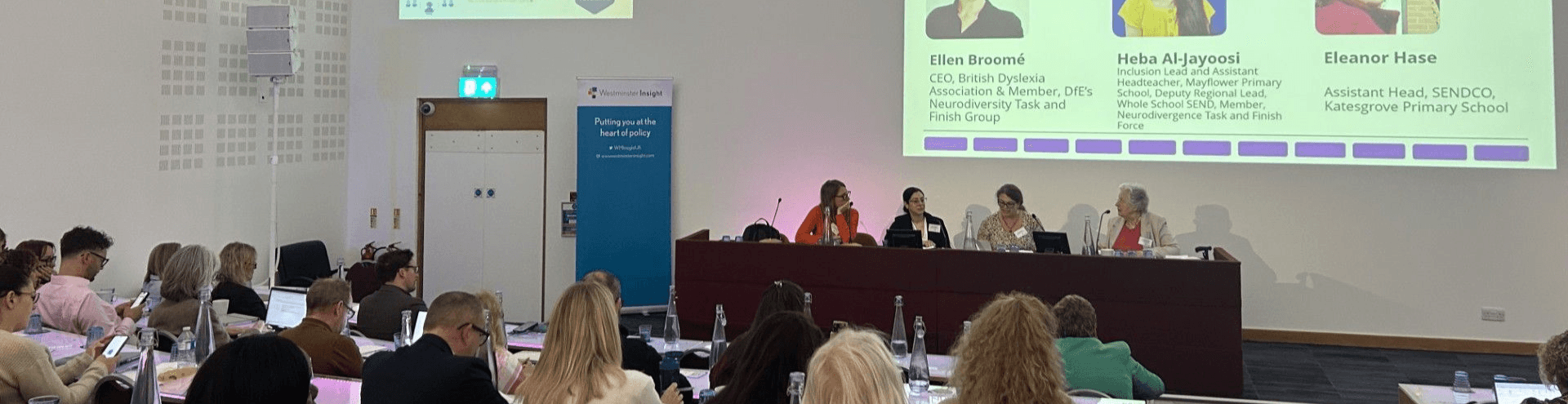
Westminster Insight’s SEND Reform conference brought together expert chair Dr Rona Tutt OBE with MPs, local authority leaders, SENCOs and sector specialists in London on Thursday 14 May 2026. The day focused on what the government’s SEND white paper proposes and what implementation will demand of schools, local authorities and health partners. The consultation closes on 18 May. Here are six things to take into your planning before then:
The white paper sets out one inclusive system underpinned by National Inclusion Standards, with £1.6 billion over three years going into an Inclusive Mainstream Fund. Above a Universal Offer of high quality teaching and support, three tiers structure additional help.
National Inclusion Standards will be set by experts and reviewed every two years for mainstream provision and every five years for specialist provision.
The white paper proposes that every school will have on-site access to specialists, including speech and language therapists and educational psychologists. The government has set out investment in recruiting and training these experts, and specialist schools will deliver outreach support to mainstream settings. Some specialists will also work with individual children holding EHCPs.
This was the question delegates returned to most often. The opening panel with Andre Imrich OBE, Jess Asato MP and Amanda Wright of Nasen pressed the same point. The expertise brought into schools must be greater than the expertise being outsourced, and current workload and capacity are not where they need to be.
Dr Rona Tutt’s view was that the answer lies in using whoever schools can call on, including SENCOs and special school colleagues, and treating the moment as a chance for innovation. Whether the funding stretches to match the ambition is still to be settled.

When schools are inspected under the new inclusion framework, the test will be whether the strategy is understood across the whole school community. Inclusion has to be owned by parents, children, classroom teachers, governors and senior leaders, not by the SENCO alone.
The conference returned repeatedly to high expectation and high aspiration as the starting point. Structural reform without that culture risks delivering structures and missing outcomes.

4. What is an Inclusion Base and what makes a good Additionally Resourced Provision?
Additionally Resourced Provisions, often called inclusion bases or ARPs, are small specialist units within mainstream schools for pupils with EHCPs. They typically support children with autism or speech and language needs while keeping access to mainstream learning.
Christopher Leese, Technical Director at TG Escapes, set out the design question that the white paper has not yet answered. There is no working definition of a good inclusion base. He showed examples of ARPs built to support the whole school, including flexible space for short medical interventions where that capacity had previously been missing. For now, the picture of what good looks like will need to come from practice rather than guidance.
Elaine Allegretti, Strategic Director for Children’s and Adults at the London Borough of Barking and Dagenham and SEND lead for the Association of London Directors of Children’s Services, was joined by Hero Slinn, formerly a Local Authority Director of Inclusion, and Dr Jack Walker, Designated Clinical Officer for SEND at NHS Norfolk and Suffolk ICB. They described very different experiences across the country, with implementation depending on local circumstances, relationships and leadership.
The panel called for more integration nationally and across the system, and for the day-to-day challenges faced by SENCOs to feed into strategic conversations. Their advice to delegates was practical. Engage in local forums, give feedback, and where leadership is strong that feedback will be heard.
Ellen Broomé, CEO of the British Dyslexia Association and a member of the DfE Neurodiversity Task and Finish Group, closed the day with the group’s published recommendations.
The headline shift is towards a needs-based approach rather than a labels-based system. The group recommends a stronger focus on executive functioning, the cognitive processes that help children manage tasks, organise information, regulate emotions and adapt to change. Difficulties with executive functioning are shared across dyslexia, ADHD, autism and developmental language differences, so support should respond to functional need rather than diagnostic category. The intention is to bring help to children earlier, without waiting for a formal diagnosis.
The recommendations also push co-production. Findings, assessments and support plans should be developed in partnership with school staff, parents and carers, plus the children and young people themselves.
The white paper proposes National Inclusion Standards, but those are still to be set by experts after publication and government has not yet issued its own working definition of inclusion. In the meantime, Ofsted has published one of its own, and from November 2025 it is the definition that will shape inspection outcomes.
Under the new Ofsted inspection framework, inclusion is a standalone evaluation area on a school’s report card. It covers how well schools identify and support pupils who face barriers to learning or to their wellbeing. The groups named include socio-economically disadvantaged pupils, pupils with SEND, pupils known to children’s social care and pupils who may face other barriers, including those with a protected characteristic.
For schools, this is the practical position until the government publishes its own definition. Two definitions may eventually sit alongside each other, and how well they align is one of the open questions delegates will want answered before the white paper proposals move into delivery.

The SEND white paper consultation closed on 18 May. Whatever the final shape of the reforms, the questions raised at the conference about workforce, definitions, funding and the role of local authorities will follow schools and local authorities into delivery.
Westminster Insight will continue to convene policy leaders and practitioners as the reforms move from consultation to implementation.

Office 2, Unit 51-54 Maltings Place, 169 Tower Bridge Road, London, United Kingdom, SE1 3LJ
Registered in England and Wales.
Westminster Insight is a division of The Knowledge Exchange Group Ltd (08808447)


